
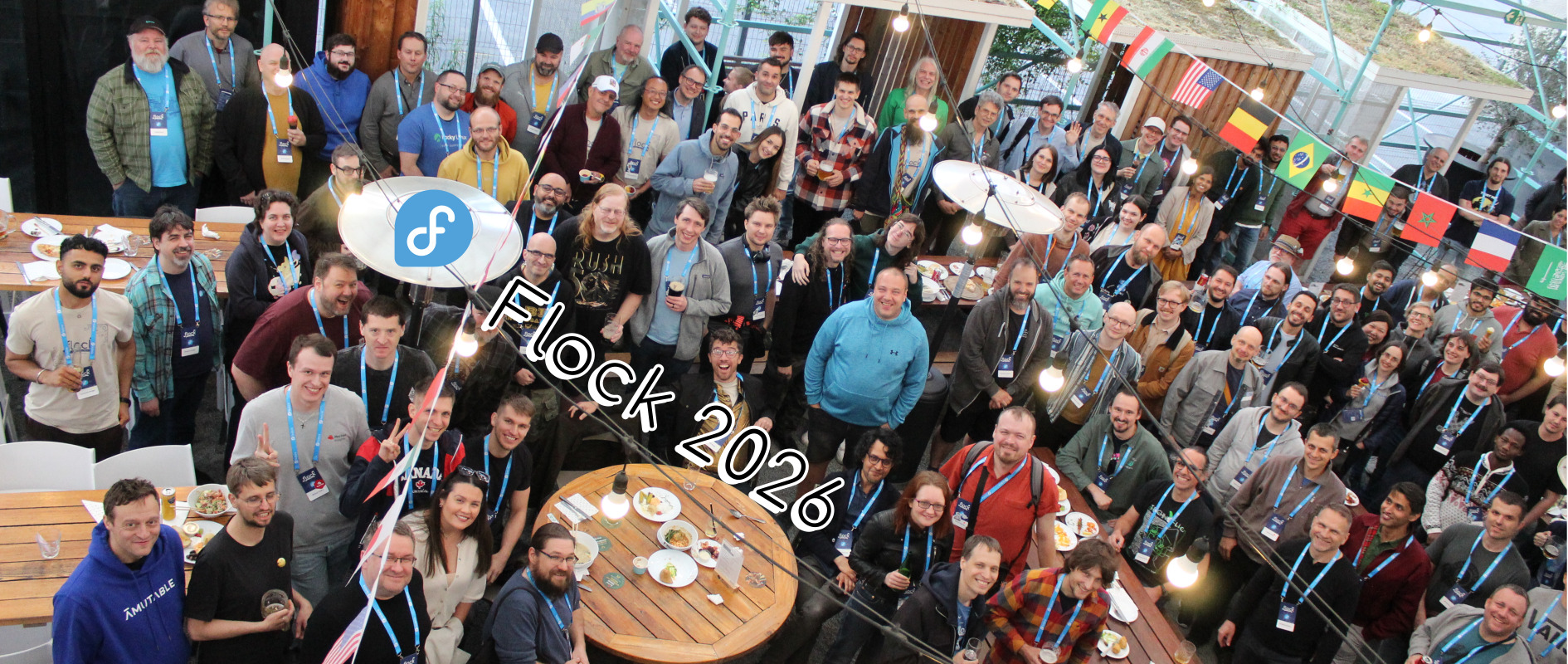
In the blink of an eye, it was over almost as quickly as it began. But the three days at the annual Flock to Fedora conference from 14–16 June 2026 in Prague, Czechia were packed with the kind of engagement that keeps the Fedora community going. Flock to Fedora, or often simply referred to as Flock, is the flagship contributor community event for the Fedora community. Flock is a place where the "doers" of our community gather annually to share our work, discuss ongoing collaborations, and shape the future of our next year ahead. Ultimately, it is one of my favorite parts of the Fedora Project. Being one of the lead organizers is one of the greatest privileges of serving in the Fedora Community Architect role at Red Hat.
This blog post is my attempt to capture the highlights of Flock 2026 while they are fresh in mind. The Linux and open source media already began their coverage. So, I thought this was a good moment to share my perspective on the event. This was my ninth Flock that I have attended and the fourth Flock where I played a leading role as an organizer.
Note | This is the first post in a three-part series on Flock to Fedora 2026. The second post covers how Flock gets organized behind the scenes. The third post shares my personal reflections on organizing Flock as Fedora Community Architect. |
The Hallway Track 🔗
I often tell people that the 45 days before Flock are some of the most stressful days of my entire year. But all four times I have done this, once I actually arrive at Flock and the conference gets going, the stress melts away. I am still running around a lot, taking care of this or that, but the important things always come together. Our speakers deliver great content, people reconnect after a long time of not seeing someone, and the hallway track is constantly lively. This year was no exception. I was pleasantly pleased to see and hear the community vibe which is essential to Flock was once again re-created.
Both my lived experience from nine years of Flock and the post-event data since we began collecting it in 2024 tells us one thing, absolutely. One of the most-valued parts of the Flock to Fedora experience is what is commonly known as "hallway track." If this is a new term to you, it is not too hard to understand. It plays on the idea that while there are usually tracks of speaker programming and content at a conference, there is also an unspoken track on the schedule. This "hallway track" is the informal conversations that take place outside of the speaker halls. They happen organically and they are usually unscripted. In-person attendees of Flock have been telling us for years that the "hallway track" at Flock is a critical, spotlight part of what makes the event worth attending.
Figure 1. A group selfie of people wearing blue Flock to Fedora conference lanyards seated at a dining table featuring a handwritten "Development" sign.
So, while it appears the Fedora community has vast opinions about Flock, what it is, and what it is supposed to be, we all seem to agree on one thing. Getting the face-time to speak with other Fedora contributors is invaluable and drives critical engagement that keeps people in our community. I genuinely think without Flock to bring our core contributor community together once a year, we might all be burnt-out, exhausted, and tired from the online engagement we have been doing for more than 23 years. The in-person time is where the Fedora Friends Foundation comes out on full display. The hallway track is where people can go from colleagues to friends. When we talk about building trust in a community, it is experiences like the Flock to Fedora hallway track that turn trust-building from a concept to a concrete, practical thing.
"Generational Switchover" and Packager Data Trends 🔗
One of the most poignant parts of Flock 2026 came in the "State of Fedora" keynote delivered by the Fedora Project Leader, Jef Spaleta. Several thoughts were put forward, but what clearly generated buzz was a graph produced by Michael Winters from the Fedora Data Working Group.
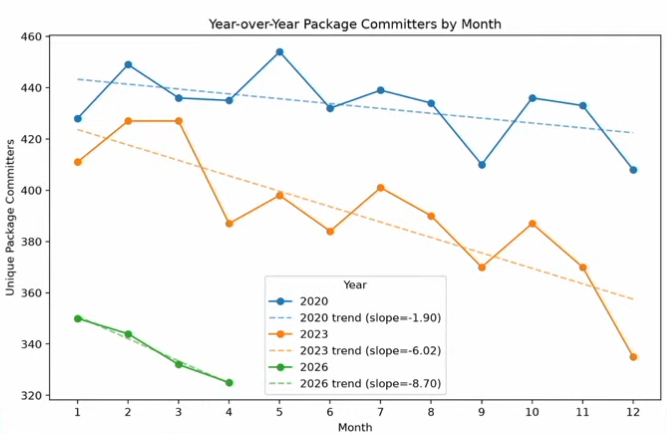
Figure 2. A line graph titled "Year-over-Year Package Committers by Month" showing a downward trend in the number of unique Fedora package committers across the years 2020, 2023, and early 2026.
Michael single-handedly developed user-level access to the wealth of packaging data we have been working to analyze, and the result was a striking visualization of the number of unique package committers in Fedora over a six-year span. The graph shows what seems to be a significant decline of the number of unique packagers actually working in Fedora Linux over a six-year span. The data appears to indicate a sharp decline in the number of unique packagers in 2026 so far versus the unique packagers in 2020 and 2023. It is a graph that is certainly concerning.
Jef put forward theories of what he thought the data could be indicating. At one point, he mentioned the idea of generational switchover, and that one era is ending and a new one is beginning. In the session following his keynote, the Fedora Council Q&A, this topic of generational switchover came up even more. Obviously, people felt concerned or triggered in some sort of way by this data. While the Fedora Council originally planned for the panel to focus more on a "what/how" conversation, we ended up having more of a "why" conversation with attendees.
It was a comment made by Aleksandra Fedorova which really stuck with me. At one point, she and I had touched on a shared experience for an in-person F41 Release Party in Potsdam, Germany. The interesting part of this was the unique intersection of both the local organizer, René Kuhn, and newcomer, junior students from the university (i.e., where the event was held) and old-timer, experienced contributors like myself and Aleksandra. Aleksandra mentioned that her experience at this F41 Release Party reminded her that the young people and students of today were just like many of us with several years behind us were when we began in Free Software and Open Source. She said that it was not actually young people who were changing, but us, the people who had been here for years, who have changed. We are no longer the same young people we were. We are more experienced, more exhausted, perhaps more burnt-out, than we were in our own youth and entry to the Free Software movement. I encourage you to watch the full panel discussion once it is available, but this is a thought that is sticking with me after Flock ended.
Record-Breaking Sponsor Engagement 🔗
We had a record-breaking level of engagement on the sponsor side of Flock 2026. We raised more sponsorship funding from a larger number of unique sponsors than we have received in years. This milestone shows us a couple of things:
We have a diverse group of engaged sponsors, mostly from downstream products and companies, which care about the sustainability and well-being of Fedora.
We are growing the amount of sponsorship for Flock to Fedora, which can enable us to think on a bigger, grander scale for future editions.
Our processes are getting better at selling Flock sponsor packages, and processing contracts, purchase orders, and invoices.
The sponsorship side of Flock really became more critical after the COVID-19 pandemic, when we returned to Flock to Fedora after a few years of Nest with Fedora virtual conferences. I remember as an attendee from 2015 to 2019 that while there were other sponsors, it was obviously Red Hat who was the most engaged, the most committed, and the one footing most of the actual costs. To be honest, this is still true today. However, the pool of engaged sponsors is diversifying. We have more commercial downstreams from Fedora Linux than we have ever had at any point in our history. To me, this represents healthy growth, even if it does raise more questions about how to sustain that growth and balance the increasing interest in Fedora Linux in a fair and equitable way.
Everyone tries to influence the direction of a project they care about. That is simply how communities work. What matters is whether the processes for exerting that influence are fair, equitable, and open to everyone. In Fedora, they are. Our sponsors do not buy influence in Fedora Linux. What is impressive about most of our Flock sponsors is that there are often coordinated groups of paid engineers and contributors from these companies who show up to do real, actual work in the Fedora community. They submit Fedora Changes, get them reviewed by FESCo, and integrated into Fedora Linux — the same process available to anyone. Our hardware vendor sponsors can also participate in initiatives like Fedora Ready, to provide greater assurance and information for Linux consumers to purchase hardware which has a guaranteed quality experience with Fedora Linux. Our sponsors are not complacent and they do not rely on financial sponsorship to get them special favors. If they want something done, they show up and do the work themselves, together with the input and participation of the rest of the community.
A special thank-you to the individual folks at our various sponsoring organizations who raise the Fedora Project flag in their teams, departments, and entire organization. Without you, these special, collaborative relationships we have would not be possible.
Fill Out the Flock 2026 Post-Event Survey! 🔗
If you are reading this blog post, attended Flock in-person or virtually, and it is before 8 July 2026, stop everything you are doing. Go and complete the Flock 2026 post-event survey right now. This is only because it is the most important part of the entire future Flock planning process. As one of the people with access to the data and also involved with the planning for future Flock editions, nothing else matters more than this. While I am always listening to what people have to say in the hallway or making my own observations at the conference, the survey gives us real data to understand what people think and feel about Flock to Fedora. I always read every single comment and response in the survey. It matters to the entire Flock organizing team that we build an event that reflects the desires and wishes of our community.
The survey is open to both in-person and virtual attendees. We know that the Fedora community is global and spread out all over the world. We also know that travel is not necessarily an equitable act; not everyone can afford to travel, or even is physically able to travel. Therefore, we invite everyone who considers themselves a part of the Fedora community and participating with Flock to share their opinions.
After all, if we only sent our survey to our in-person European conference attendees, it seems quite likely that we will keep hearing about how Europe is the best location for Flock. So, even our virtual attendees and people who could not travel in-person to Flock 2026 can share their feedback and voice to help us make a better and more inclusive Flock in the next editions.
More in this series 🔗
This post covered the highlights of what happened at Flock 2026. But there is more to say about how Flock gets organized and what the experience means on a personal level.
How Flock to Fedora gets organized: A look behind the scenes at the team, the workflow, and the paperwork that goes into producing Flock.
Reflections on organizing Flock as Fedora Community Architect: What organizing Flock has taught me about community, inclusion, and the future of the event.